Now that I no longer feel like a blade of grass in a strong breeze, it is important to both of us that we try and give you some useful messages and positives about something that created chaos in our lives. So here are 10 lessons we learnt from going through cancer.

1. Have Regular Checkups
Schedule your regular health checks without fail. Don’t defer them, don’t miss any. They can save your life. I was lucky the cancer was found early when it was still small through a routine mammogram. But it does not just come down to luck. I had a breast screen every two years without fail for the past 25 years. Discovering something life threatening early is key to your chances of recovery and long-term survival. It is far less difficult to deal with a small tumor than a large one which has had time to spread via the lymph nodes. Early detection also has an impact on the severity and length of treatment. This applies to all cancers. The whole process for us from initial detection to end of treatment took nearly five months. It was far from fun. But things would have been a lot worse if I had not been vigilant.
2. Be Informed
Find out everything you can about your cancer and your proposed treatment plan. Study, learn, research. Information is power. Use the internet for good and read. Visit the Cancer Council and Breast Cancer Australia websites in this country and reputable websites overseas. Read patients’ accounts, talk to specialists, ask questions, lots of questions. There is a mass of information available. You just have to access it and digest it. As you do your research, write your questions down then direct them to your oncologist, surgeon, radiotherapist, GP, nurse. Take advice of course, but remember you know yourself better than anybody else does, and you have the ultimate decision-making responsibility. I am neither courageous nor brave. But I am stubborn. I will not follow blindly. Every appointment we attended, I had a long list of questions and the answers I received shaped the decisions I took about my own treatment.
3. Lean on a Supportive Partner
Having a partner to support you is incredibly important. When you are back against the wall, you need someone to help you move forward. Your life partner has a multifaceted and at times thankless role: to love you when you feel far from lovable, to dig you out of emotional holes, to be your nurse, to encourage you, to correct your thinking when it is clearly out of kilter, to protect you, to put up with your widely swinging moods, to deal with their own fears, to cope with the boredom as their life and normal activities are on hold. Watching your loved one in pain physically and emotionally is hard. You wish you could take the trauma away. Partners have a tough gig and they too need support.
4. Connect With Friends
When you are scared, debilitated and in pain, you need a good network of friends and a few empathetic ears to vent with, cry with, joke with, and just chat about things other than your treatment. I found at the worst times when I felt I could not keep the anxiety to myself, I had to ring someone to let it all out and find relief. I am so grateful for the precious few who were there for those tearful calls, who were able to calm me down and ended up making me laugh. Those few acted like family – my cancer family. They did anything they could to make my time easier. They sent body lotions, chocolates, tasty food, books, they’d recommend Netflix shows, they’d do a yoga session with me, send me meditation music and just talk to me. They were my biggest cheerleaders. A lovely surprise was the number of contacts from the cruising community who also came forward with messages, offers of help or even their own cancer stories and suggestions. I never felt alone.
5. Expect Different Reactions
A big surprise was finding that people had different reactions to our cancer news and treatment. Some didn’t know what to say, how to help or found it too confronting and became distant. It hurts when people you think are close go missing in action during your treatment. Fortunately, the majority of our friends, and a few acquaintances we did not really know before, proved invaluable. They “turned up” as we like to call it, either because they naturally empathized, cared deeply or because they had been touched by cancer themselves and understood all too well. We are grateful to all those who stayed close and showed they care. It made a big difference.
6. Let Go of Anger
It’s healthier to forgive than to hold onto the anger. Cancer makes you angry. It changes your life unexpectedly, takes the lives of loved ones, and it changes your relationships. But you need to be kind and forgive. Be kind to yourself and forgive those who disappointed you. Anger will only eat you up inside and it’s not worth your energy.
7. Exercise
Staying active has a huge impact on your physical and mental wellbeing. Do whatever you can to start or stick to an exercise routine while going through treatment because you will feel better, more in control and focused on something positive for your battered body.
This episode was the kick in the backside we needed to focus on our fitness. We had become a bit too sedentary and needed to change this. As we age, exercises that promote mobility, flexibility, strength and balance become even more important – cancer or no cancer.
8. Nothing is Permanent
When you’re in the thick of a really bad time, whether it be cancer treatment or something else, it can be hard to remember that this too shall pass. Enjoy the good times while you can and when the bad times come, know that it won’t be forever.
9. Do What You Love
Be ferociously determined to push forward and do what you love. We have both had a cancer scare. We are both survivors and are fortunate we can maintain our lifestyle of choice. But we also know that things could have turned out very differently. Life is short, so focus on the important stuff: having supportive people around you, having a sense of purpose and using the energy it generates for good. For us it is about living our life with zest, cultivating curiosity, having a sense of fun, adventure and achievement.
10. Stay Vigilant
Cancer is an uninvited lodger who turns up, takes over and messes things up. You finally get rid of them, then realise they’ve kept the key. So keep those follow up appointments going. Stay vigilant and keep that interloper at bay.

**************************************************************************************************
Freedom at last
We are ready to go, leaving Marina Mirage on Monday after three months here and a month at the Boat Works… We are not 100% but good enough to make our escape. You know what they say: if you wait for perfection, you never leave the dock!
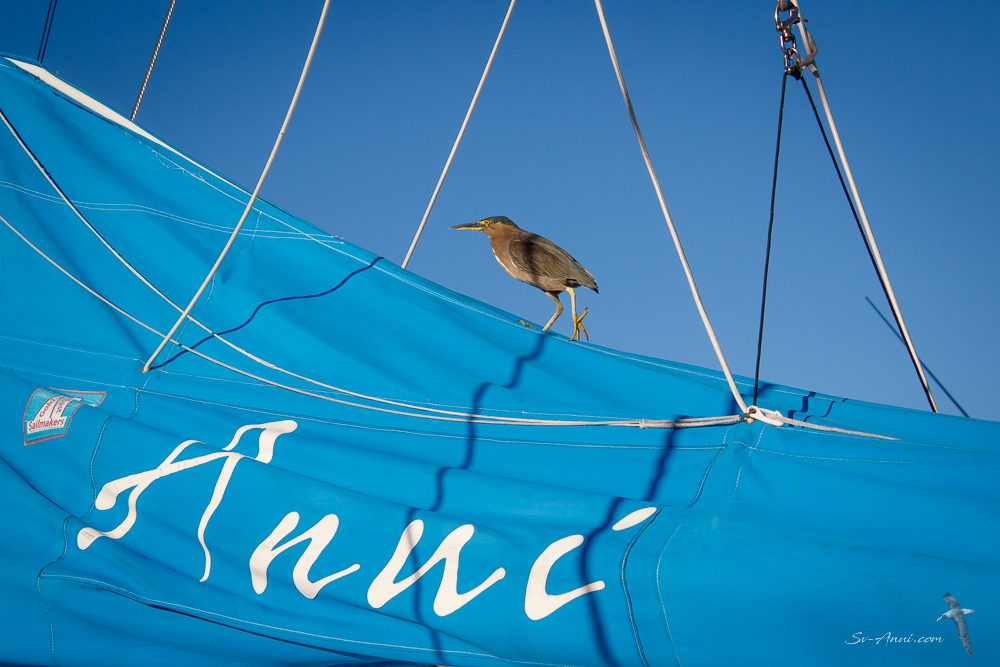
A friend is joining us on Sunday for a couple of weeks and we will be taking it easy, starting gently in Moreton Bay to get our sea legs back in company. We are saying goodbye to friends old and new and to Heriot, the night heron, who made himself at home on Anui.



 Sv-Anui
Your advice is very sound, hands-on teaching is the best teacher. I’m so glad that you guys are finally getting back on the ocean! Best wishes and have fun, guys. ❤️😎
Hi John, back to doing what we love in a few days. Getting the boat ready to go after 4 months out of action.
Yay!!!
it’s about time. Which is probably exactly what you are thinking. I wonder if Heriot will find the next boat so accommodating. 🙂
Hi Trish, yes it’s been the longest and rudest interruption to our sea wanderers’ life. But we are finally well enough to go. We will miss Heriot, such a little character who got used to us and Bengie.
Comment received from Sue:
An informative blog, and it is such good news that you are leaving on Monday, ocean bound. Enjoy your freedom and your new life on Anui, You have done all you can to defeat this monster. Stay Well and safe
It is a relief to start thinking of our life afloat and shortly leave the Gold Coast and trauma behind! Thanks Sue!
A wise and thoughtful post, Chris and Wade. So glad you’ll be back bobbing at anchor very soon and your healing continues.
Can’t wait to give you overdue hugs in person ❤️
Thanks Helene, yes it is time to resume our sea wanderers’ life and have some fun again. Bear hugs coming soon! 🥰
Chris, I’m sorry I haven’t sent you a message after your last few posts. Wrist op, a daughter who had to have a melanoma removed from her leg, no internet, can’t drive & COVID on top, have all put me in the wrong space. All so very very minor in comparison to what you have gone through. I’ve read every word you have written, most of which brought tears to my eyes. Where in the hell do you get your incredible strength from. You are amazing! Your 10 lessons learnt, for me, highlight 2 really important things to be mindful of. Have regular checkups and stay ever vigilant. We take so much of what we have for granted. Keep doing what you are doing. You will get there Wade did and you will too. Just look forward as you are doing. No looking back Those days are done. GOOD ON YOU. 🙏
Oh Caroline, sad you have had a few medical upsets and frustrations but so grateful for your feedback. You speak of strength but you know, when faced with all the big C stuff, you have no option but to get on with it… you grin and bear it, you do what you have to and you push through. No choice but to! We are on the other side of the hill now with a renewed taste for adventure. Take care and look after yourself.
We’re excited for you guys! Can almost feel your joy and relief at getting away from your marina exile. Looking forward to your regular posts as the healing continues in the languid waters of the north!
Bon voyage cobbers!
It was quite an odd and momentous feeling leaving… had to remember how to do things as we were looking back at our empty spot at Mirage and felt the boat come alive!
I reckon it’ll be like riding a bike!
We (ie me and her) are going through a 2nd bout of cancer and your points, particularly 6, is spot on.
A second bout would be very tough to go through, whether for your partner or yourself. Getting angry about something you can’t control or people who don’t behave the way you wish consumes precious energy. Hopefully you have a good support group around you. That’s what I found most helpful. Very happy to chat if you want to. We can exchange phone numbers privately.
Thanks Christine
The support group have been invaluable, the clinic that she is attending have a strong care component with a psychologist on tap to assist with the anxiety that can be generated by the procedure.
Historically this is an aspect that hadn’t been given much consideration, patients just had to toughen up. They now recognise that post treatment can present another source of anxiety, which can impact on the recovery process.
We know it takes months after the treatment has ended and it’s the mental game that is most challenging.