For the second post in our August 2023 Coral Sea series, we leave the protection of the Great Barrier Reef and head out to the Flinders Group, approximately 100nm north from our last anchorage at Kangaroo Reef.
A bit about the Flinders Group
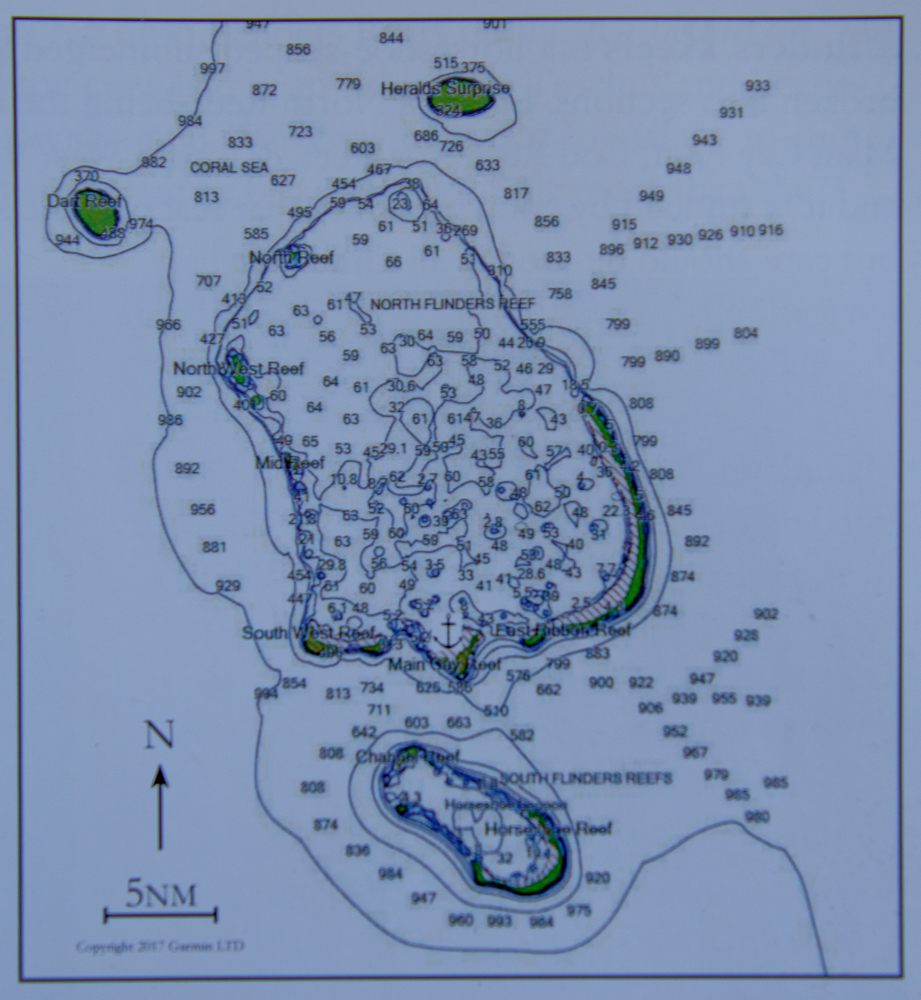
The Flinders Reefs Group is horseshoe-shaped submerged atoll laying upon the Coral Sea Plateau. For those who don’t know, an atoll is a ring-shaped marine feature made up of coral reefs, an island, a series of islets or a combination of all three along its rim, with an encircled lagoon which can vary in depth. At Flinders Reefs it is about 50m. Channels in the rim of the atoll connect the lagoon to the open ocean.
The Flinders Reefs are in several sections. North Flinders is the largest, consisting of North Reef, East Ribbon Reef, Main Cay Reef, Cod Reef, Toe Reef and Northwest Reef. Nearby are also separate reefs: Heralds Surprise and Dart Reef lying to the northwest and northeast respectively of the main reef.
South Flinders is another oval shaped atoll made up of Channel Reef, Horseshoe Reef and Entrance Reef.
Here is a chart copied from Peter Sayre’s, Australia’s Coral Sea Islands and Marine Park, our bible.
Passage to Horseshoe Reef
We left Kangaroo Reef by 3.00pm and headed straight north. We reached the last dotted line of reefs and were dropping off the edge of the Continental Shelf by 7pm, quickly going from 60m depth to 80, 100, 120… and eventually our depth sounder stopped registering but the charts showed 1000m!
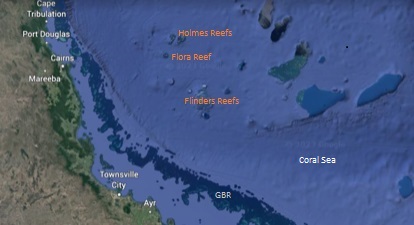
We have included another Google chart showing the coast, Great Barrier Reef and a few of the atolls in the Coral Sea. You can also see the grey line on the outside of the GBR which shows the edge of the Continental Shelf.
The evening was somewhat windier than we expected, with 12-18 knot SE. We had the jib and main up and sailed all the way. The ocean was rolly but not uncomfortable, the sky lit by the Milky Way. We had a beautiful night, one of our easiest overnighters. We sailed at a faster pace than we expected and had to slow the boat down, but still arrived at the edge of South Flinders too early to see anything. So we floated about and waited.

We were still in over 1000m of water according to the charts, but within a few hundred meters from the rim of the atoll, our sounder woke up, showing a depth of about 50m. We were looking for one of the gaps in the oval rim to get inside and motor to the southern edge: to Horseshoe Reef. The sat map helped, but it was still an act of faith going in! The skies were grey with rain showers in the distance, the ocean inky black, the gap to get in not that wide… But we need not have worried.
We made our way to the shallow area at the bottom of the horseshoe and anchored in clear sand in 8m of water. It was grey, a little chilly and jiggly but okay. Bacon and eggs for breaky, then a check of our emails, weather, and upload of our post on the website, then a snooze. By the time we re-surfaced the weather had improved, the tide was lower and it was time for a drone flight and snorkel!
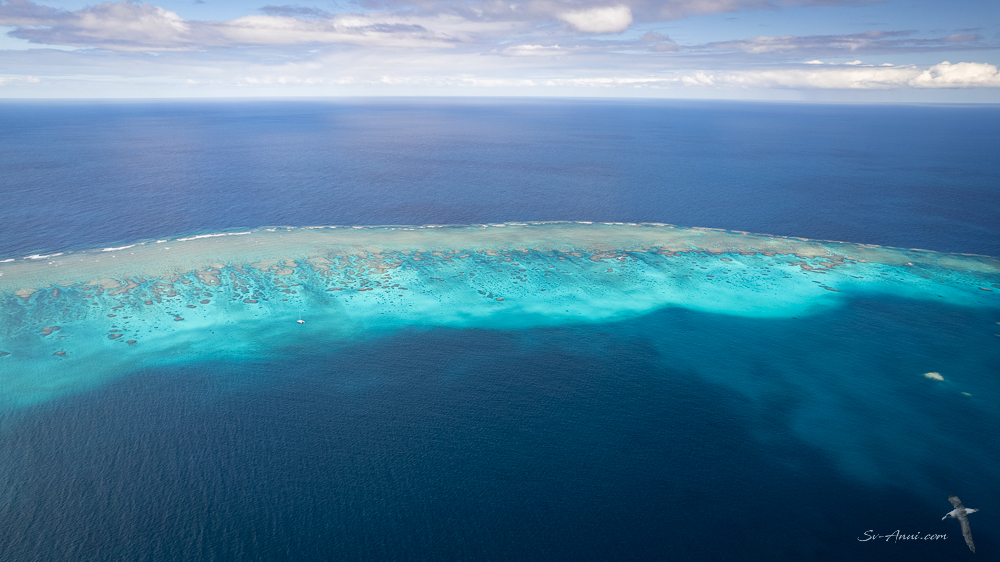
It was impossible to get an aerial shot that showed the rim of the atoll we were in as Horseshoe Reef is so vast. But here are a few images which will give you an idea of what it looks like. The aqua strip is 5 to 10m deep, the dark blue 30-50m.


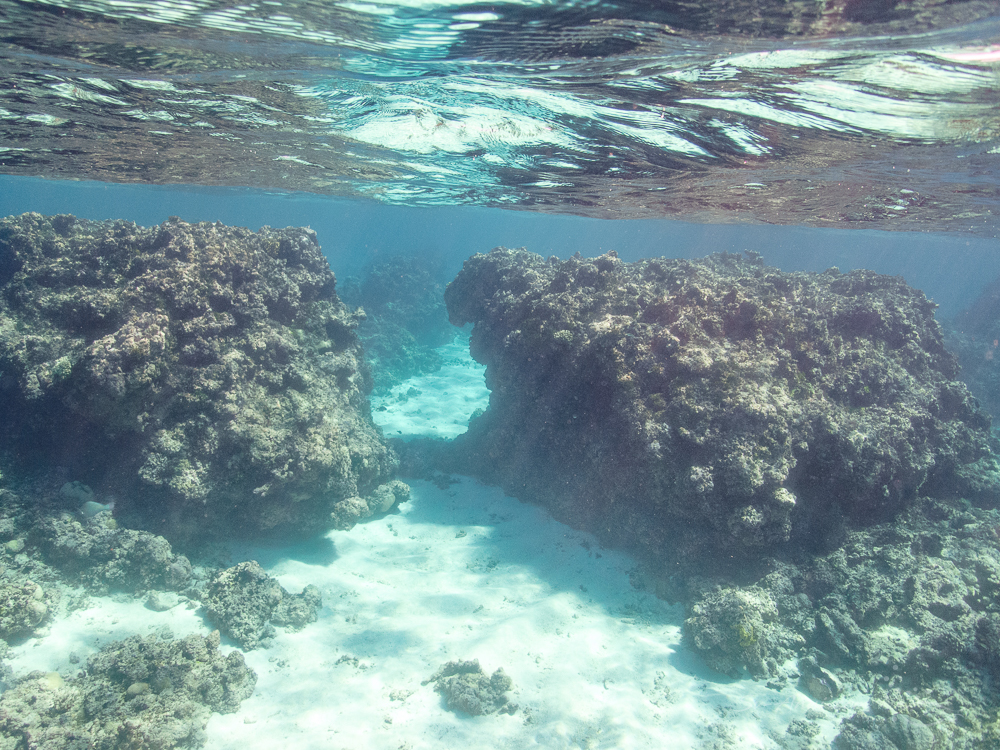
We had a brief snorkel around the bommies and gutters in front of the boat, but it was disappointing. Although the water clarity is excellent, you get the brilliant view onto a graveyard, just like at other atolls we went to last year. It was not all that surprising and made it easy to move on the next day!
We have included one shot of a gutter, not because it is pretty, but to give you an idea of what most of the reef was like.
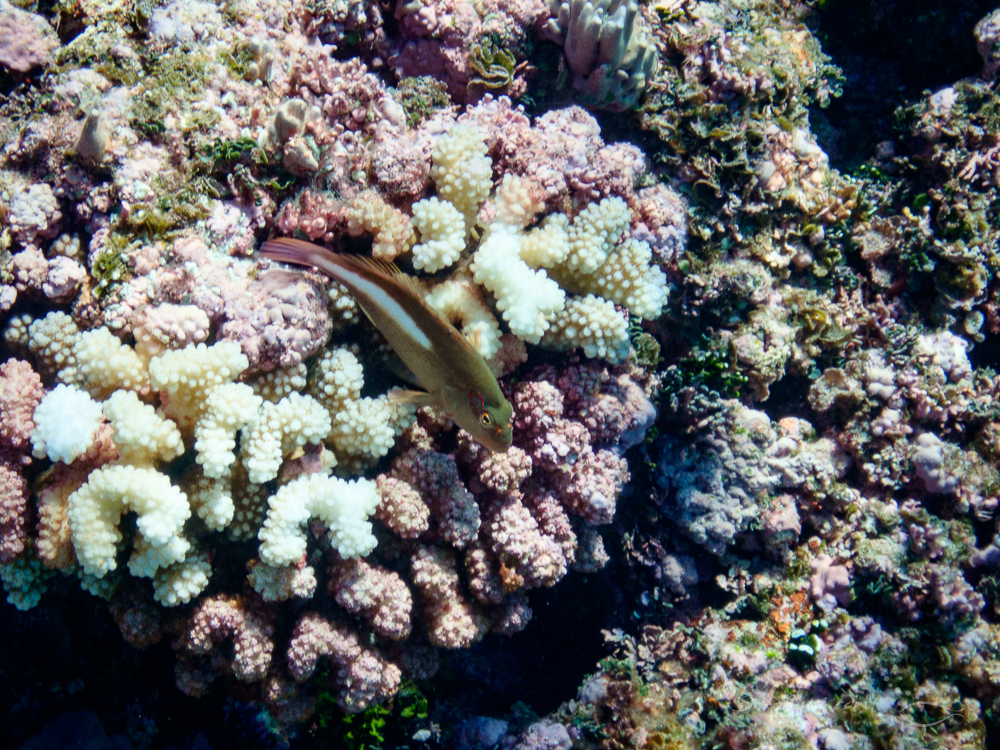
The one interesting find: a whitelined Coralgoby, just resting on a rare patch of colourful coral, with its pectoral fins holding him in place like hands, unafraid of the photographer.
North Flinders Reefs – Main Cay
The next morning, we followed the edge of the atoll on the NE side, opposite to the way we came in, to a gap in the rim and exited, bound for Main Cay, North Flinders.
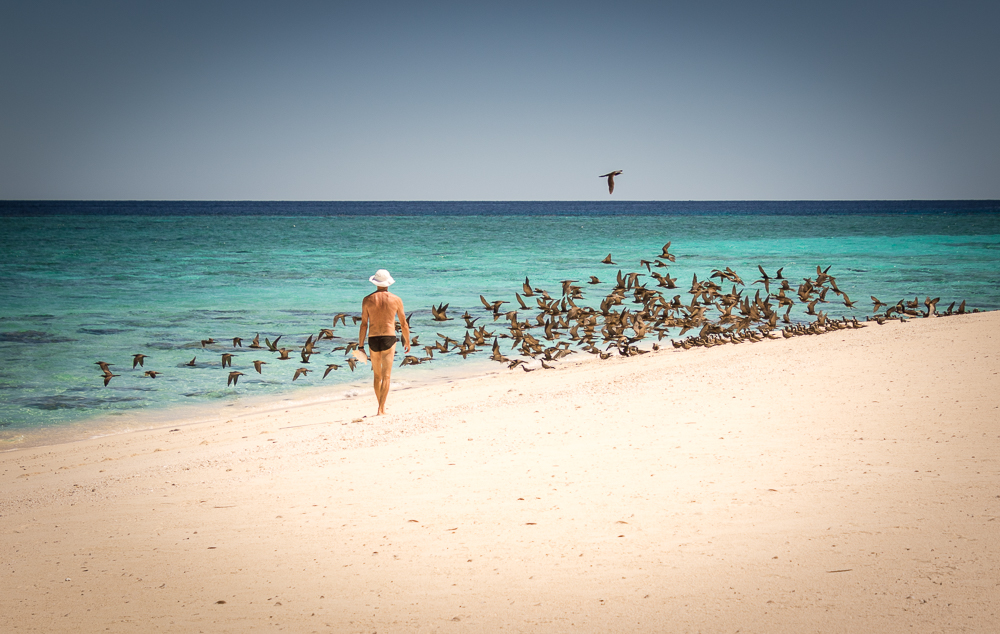
Main Cay is only 12 nm away, with a passage at the bottom of the atoll between it and Southwest Reef to get inside. The Main Cay Reef is triangle shaped. We anchored in front of the cay in a depth of 5m over a huge expanse of sand. What a spectacular place! We could not resist going ashore. There is a weather station on the cay, a thin strip of sand devoid of any vegetation, but with lots of birds vying for room to rest. Masked Boobies, Brown Boobies and Noddies congregated in small groups.



Here is what Main Cay looks like from the air. You can see South Flinders in the distance.


Central Bommies
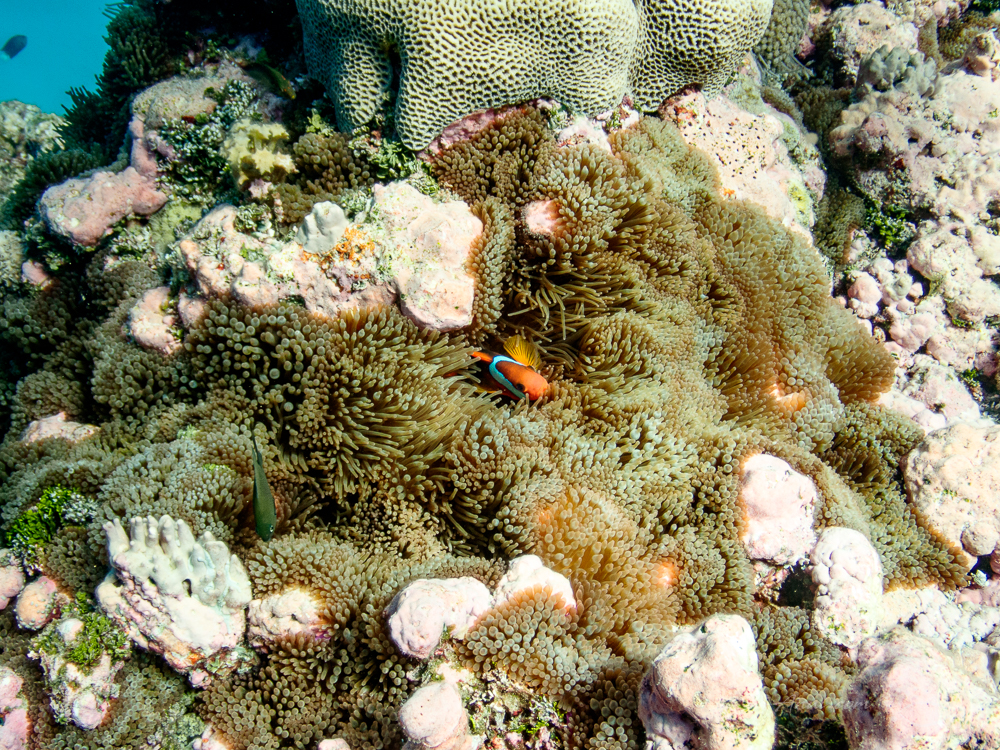
Unlike South Flinders, the centre of North Flinders is studded with bommies some of which reach the surface. Snorkeling there was interesting although the coral still showed signs of bleaching damage. We went to several of the bommies by dinghy. The pinnacles came up like mini towers, some way deeper than we could manage, with different types of Gorgonians and Crinoids adorning the sides. The visibility was very good with crystal clear water around the bommies. The challenge was holding your breath long enough to get down deep and grab the shots! It was fun and different. Near the top of one of the pinnacles was a gorgeous anemone garden, with dozens of anemonefish zipping in and out of their respective host. It was a mesmerising spectacle. Here is a gallery of our best shots. As usual, click on the first image to display in full screen and arrow right!



East Ribbon Reef
We moved to the Ribbon Reef the next day, 15nm further along. It was calm, warm, sunny… just gorgeous. Anui looked tiny, tucked in next to the reef platform in a patch of clear sand in 9m of water.


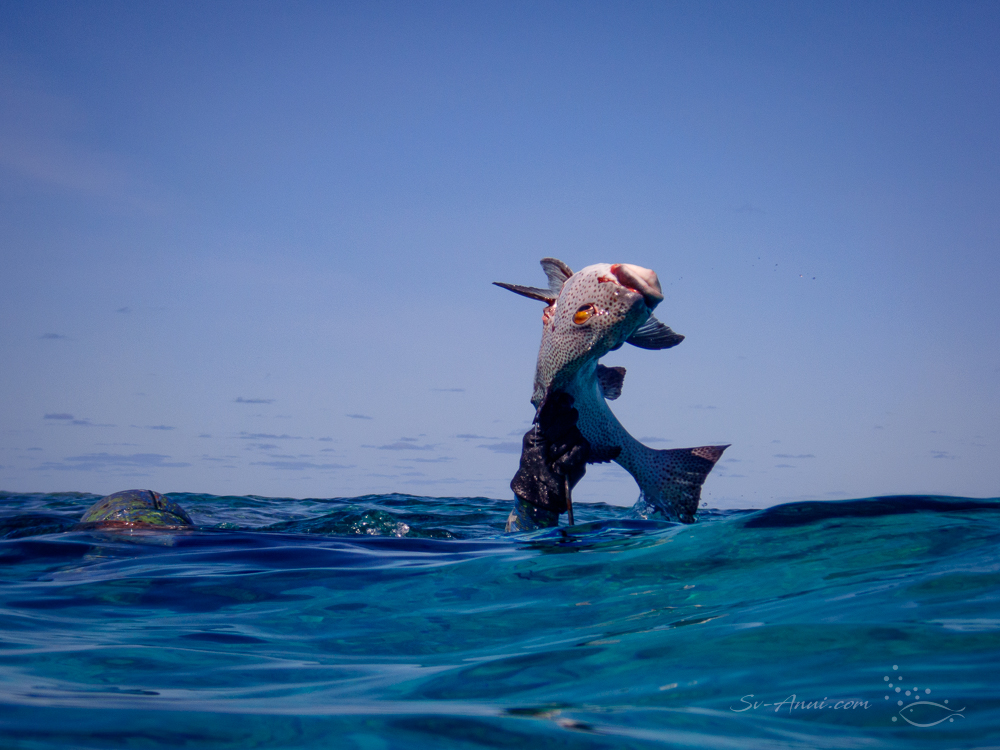
We snorkeled at a few of the bommies to the left of Anui in the second aerial, but it was not very good. Lots of fish, very clear water, however the coral was poor. The central bommies of the previous day were far better. But there were lots of fish, some rather large and they seemed quite calm around us, which for one of them was a fatal mistake. Wade caught us a Sweetlip! Having spotted a big shark, a Grey Whaler cruising nearby, he swam back hurriedly to the dinghy with the catch out of the water – we call it “fish on a stick”.



Where to next?
With several days of stronger conditions developing over the weekend and early next week we have moved to Flora Reef, some 75nm NW of North Flinders Ribbon Reef. This atoll will be the subject of our next episode! We will see how the forecast develops and make a decision as to whether we stay out or retreat to Cairns. Stay tuned for our next post in this series!


 Sv-Anui
I love the aerial shots where you almost need a magnifying glass to see Anui. What a fantastic way to see just how vast your adventure playground is.
Hi Ann, yes Anui looks diminutive in the seascape. It is hard to give a sense of the scale we deal with from the boat or from shore, but from the sky, we really get it.
Bleached or not, the reef looks incredibly beautiful! How scary that you are right on the edge of the shelf, a drop into the abyss! Thank you for sharing the beauty, guys! ❤️🇦🇺
Hi John, yes the depths are hard to comprehend. When snorkeling around the pinnacles in crystal clear water you can be mistaken when you look down, see something interesting to investigate and as you dive straight down you realise it is way deeper than you first thought! Certainly a good test for breath holding!
Indeed, be very careful!
Congratulations. New and very exciting territory where very few cruising yachties would have ventured. I looked up the observations for the Flinders Rf Tower, but no reports. Was it out of action from cyclone damage? Keenly waiting for the next legs report. Enjoy.
Morning, Graham! There were two towers at Main Cay. One was fallen over and looking very sad, but the big one seemed okay. We too have checked and can’t get any observations. In any case it was a very nice anchorage and stunning view in very light conditions. So lucky!
Thank you for my weekend ‘homework’ and the IG explanation of the almost blackish sea – fascinating! Apologies for coming across ‘multiple’ there but I seem to have a RAT in my system !!!!!! Will be attended to tomorrow . . . bestest . . .
Thought you were trigger happy! 😃
Very funny, lady! Now I have to spend half of tomorrow apologizing to everyone!!! Sadly, methinks it is an unwell friend . . . E
And here I was thinking my stats were looking good! 😝
I love the aerial shots they really show where you are. Still very sad to hear what is happening to reefs.
Hi Leanne, glad you like the aerial shots. Trying to get interesting perspectives so they don’t look all the same!
And yes even that far offshore, the damage to the reefs is extensive.
Great aerial shots Chris! Really transports us there. Such an adventure. We are in awe of how far out in to the Coral Sea you go. On your own it seems? Weather turning ordinary here too. But we’ve had a wonderful 6 days out at the reef with perfect weather. On our way to Maggie. Look forward your next posts.
Hi Amanda, yes they are big distances to get anywhere in the Coral Sea and this time we could only manage the Flinders Group and Flora Reef. Would have loved to stay longer and see more but the weather is turning nasty so we are heading back to Cairns. Haven’t seen anybody out there… yes, on our own.
Thanks for the images and story Chris!
As usual I tried finding the places in google maps, and it was a bit harder than usual. No luck with Flinders, but Dart reef got there. You are clearly off in the wilds!
Yes, it is remote! We haven’t seen a soul since we left…Google Earth does have Flinders Reefs, and funny enough I have just tried Google Maps and it displays the atolls in the Coral Sea okay, you just need to know what you are looking at as it does not give the names.
Aha, google earth is something I haven’t tried before. Will be a handy complement to maps. Thanks!
👍
Nice report and pics. Great how your drone shots show the full grandeur of the reefs from the air! Bon et heureux voyage 🙂
Hi Elgar, yes we have enjoyed seeing our surroundings from up high… different perspective and quite handy to scout out anchorage and snorkel spots.
Your post had me imagining bathing in warm tropical winter waters as opposed to a cool wet European summer.
I’ll just toast my toes in front of the photos.
Hi Bill, I would have thought it would be warm where you are!
It’s variable. Not so much really cold but drizzly and grey changing in an instant to glorious sunshine where Norway and Sweden are at their summer finest.
Good to see you are enjoying these parts of the reef. It is interesting to see that reef damage is so far into the Coral Sea. Enjoy your time there
Hi Sue, yes the damage from bleaching and cyclones goes well beyond the GBR!
Better late than the proverbial. I just got around to this post (clearly got lost in the usual mix of emails). I like the green coral shot at North Flinders – it looks fluffy!
I’ll say, nearly a year late!